
Chronic headaches are frequently a secondary symptom of a primary structural issue: Temporomandibular Disorder (TMD). When the jaw joint, muscles and nerves are out of alignment, the body manifests pain in the temples, forehead and neck.
At the Headache TMJ – Los Angeles Pain Clinic, Dr. Katayoun Omrani, a Board-Certified Orofacial Pain Specialist, utilizes evidence-based medical protocols to resolve these complex pain patterns.
Understanding the TMJ-Headache Connection
One of the most frequently searched questions is: “Can my jaw cause my migraines?”
The answer lies in the trigeminal nerve, the largest sensory nerve in the head. When the TMJ is inflamed or the disc is displaced, it overstimulates the trigeminal system, leading to neurovascular pain that mimics or triggers classic migraines.
Top Search Queries Addressed
-
TMJ vs. Migraine: Migraines are neurological, while TMJ headaches are musculoskeletal. However, TMJ dysfunction is often the trigger for a migraine.
-
Tension-Type Headaches: These are often caused by Myofascial Pain Syndrome, where trigger points in the masseter and temporal muscles radiate pain to the skull.
Common Symptoms of TMJ Headaches
Patients experiencing the following symptoms may require evaluation by a Board-Certified Diplomate for an accurate diagnosis:
-
Morning Cephalgia: Waking up with a dull, aching headache. This is usually caused by Nocturnal Bruxism, or sleep-time grinding.
-
Otic Fullness and Tinnitus: Ear pain or a clogged sensation without an infection, caused by the proximity of the jaw joint to the ear canal.
-
Cervicalgia, or Neck Pain: The muscles of the jaw and neck function as a unit. When the jaw is unstable, the neck muscles may overcompensate, leading to chronic stiffness.
-
Facial Neuralgia: Sharp, electric-like pain that is often confused with sinus infections or toothaches.
Why Generic Night Guards Often Fail
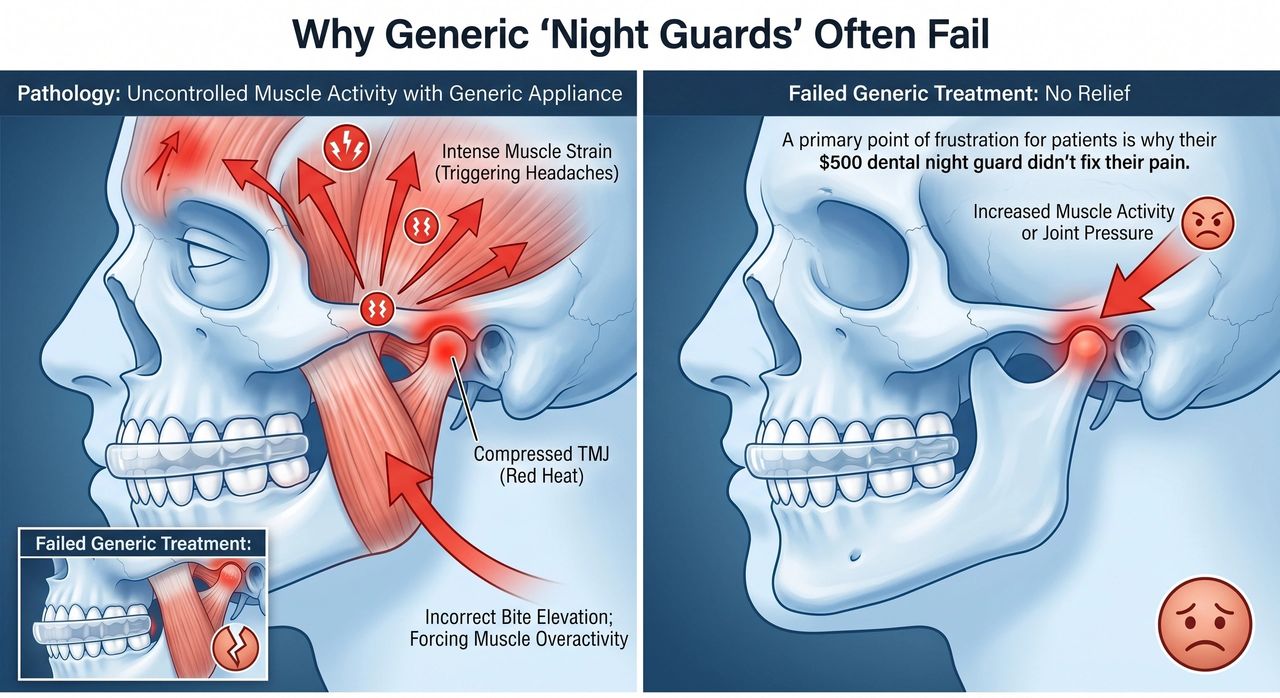
A primary point of frustration for many patients is why their $500 dental night guard did not resolve their pain.
-
The Clinical Reason: A generic night guard protects the teeth but may increase muscle activity or pressure on the jaw joint.
-
The Specialist Solution: Dr. Omrani uses 3D CBCT imaging to visualize the relationship between the condyle and disc. A medical-grade orthotic can then be created to reposition the jaw and allow the joint to heal, rather than merely acting as a protective buffer.
The Sleep Apnea and Airway Connection
Survival clenching can occur when the body stops breathing during sleep due to Obstructive Sleep Apnea. The jaw clenches in an attempt to keep the airway open, which can lead to severe morning headaches.
Dr. Omrani provides FDA-approved Oral Appliance Therapy as a portable and effective CPAP alternative for appropriate patients.
TMJ Glossary
Orofacial Pain
Orofacial Pain, or OFP, is a specialized field of dentistry recognized by the American Board of Orofacial Pain. It focuses on the diagnosis and medical management of chronic pain affecting the head, face, neck and jaw.
Temporomandibular Disorder
Temporomandibular Disorder, or TMD, is an umbrella term for acute or chronic pain involving the temporomandibular joint. It may affect the articular disc, surrounding ligaments and masticatory muscles.
Diplomate of the ABOP
Diplomate status is the highest professional credential in the field. A Diplomate has completed a rigorous board-certification process administered by the American Board of Orofacial Pain and demonstrated expert-level knowledge.
3D CBCT Imaging
Cone Beam Computed Tomography is an advanced medical-imaging technology that produces three-dimensional reconstructions of the jaw and skull. It allows Dr. Omrani to evaluate bone density, joint space and condylar position with submillimeter accuracy.
Joint Stabilization
Joint stabilization is a clinical process in which the TMJ condyle is repositioned into its most physiologically stable position within the fossa. This can help unload displaced discs and allow inflamed tissues to heal.
Oral Appliance Therapy
Oral Appliance Therapy, or OAT, uses a medical-grade, custom-calibrated device worn during sleep. Depending on the patient’s condition, it may be used to maintain an open airway for Sleep Apnea or stabilize the jaw joint for TMJ-related conditions.
Myofascial Pain Syndrome
Myofascial Pain Syndrome is a chronic pain disorder in which pressure on sensitive areas of the muscles, known as trigger points, causes referred pain in other parts of the body. This may include pain commonly described as a TMJ headache.
Trigeminal Nerve
The trigeminal nerve, or Cranial Nerve V, is the largest and most complex cranial nerve. It is responsible for facial sensation and motor functions such as biting and chewing. It is also the primary pathway for many forms of TMJ-related pain.
Neuropathic Pain
Neuropathic pain is caused by a lesion or disease affecting the somatosensory nervous system. Unlike muscle pain, it is frequently described as an electric shock, burning sensation or shooting pain.
CPAP Intolerance
CPAP intolerance refers to a patient’s inability to comfortably use or consistently comply with Continuous Positive Airway Pressure therapy. Patients with Obstructive Sleep Apnea who cannot tolerate CPAP may be candidates for Oral Appliance Therapy.