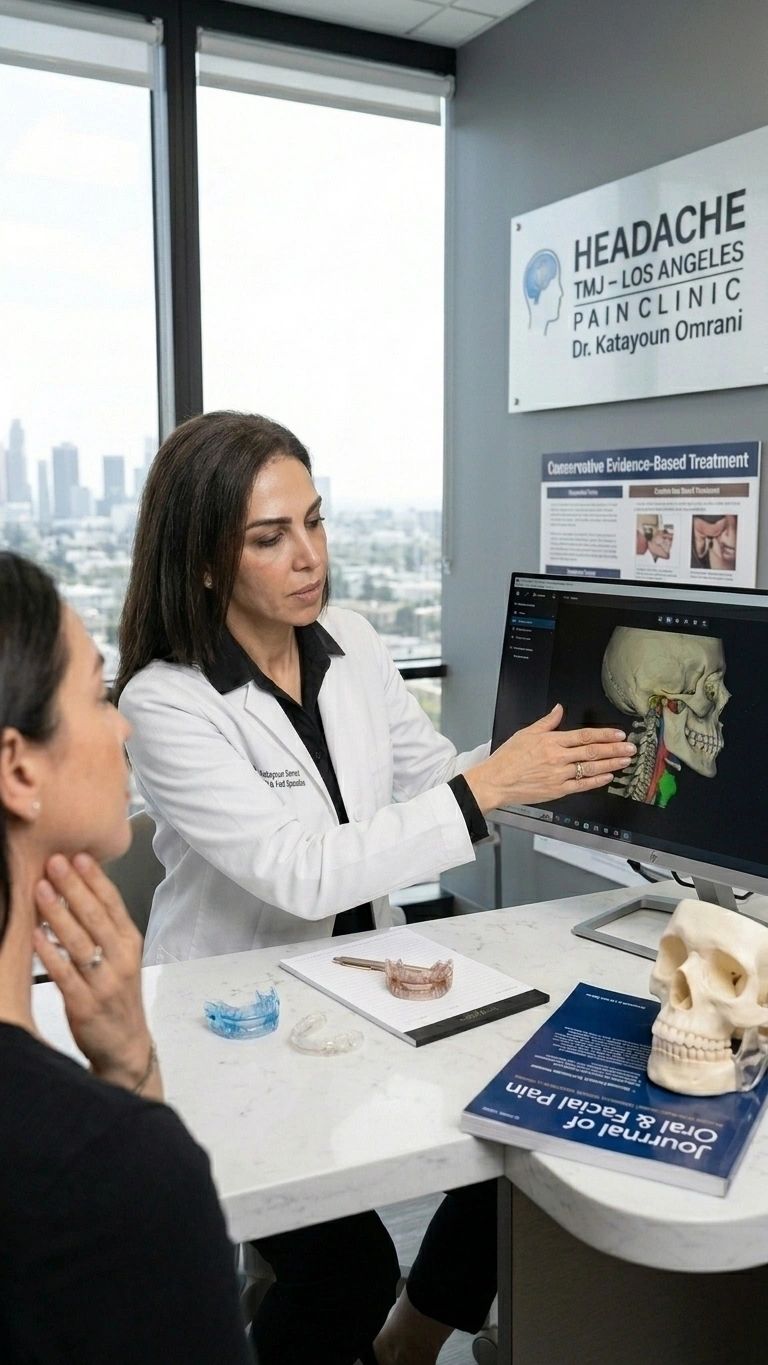
When a patient walks into my Los Angeles practice, they are often at the end of a long, exhausting journey. They’ve seen multiple doctors, underwent various dental procedures, and yet the “mystery” headaches and jaw clicking persist. As a Board-Certified Orofacial Pain Specialist with nearly 30 years of clinical experience, I have dedicated my career to bridging the gap between general dentistry and complex neurology to treat the source—not just the symptoms—of TMJ disorders (TMJD).
Understanding the Complexity: What is TMJD?
The Temporomandibular Joint (TMJ) is arguably the most complex joint in the human body. Unlike a simple hinge, it performs a synchronized “hinge and slide” motion. When the delicate articular disc between the jawbone and skull is displaced, or when the surrounding musculature becomes chronically inflamed, a cascade of symptoms occurs.
High-Search Question: “Why does my jaw click, and should I be worried?
Clicking or popping is often the first sign of Internal Derangement—specifically, a disc displacement. While a click without pain isn’t always an emergency, it is a clear indicator that the joint mechanics are compromised. If left untreated, this can progress to “Lockjaw” (closed lock), where the disc prevents the jaw from opening fully, or chronic degenerative changes like osteoarthritis.
The Headache Connection: Is it a Migraine or TMJ?
One of the most frequently asked questions I receive is: “Can my jaw really cause these debilitating headaches?” The answer is a resounding yes.
Because the nerves supplying the TMJ and the facial muscles share pathways with the nerves that trigger migraines (the Trigeminal system), jaw dysfunction often manifests as:
-
Tension-Type Headaches: A “vice-like” grip around the temples and forehead.
-
Secondary Migraines: TMJ tension acting as a primary “trigger” for full-scale migraine attacks.
-
Ear Pressure: My published research at Cedars-Sinai Medical Center has specifically explored the prevalence of Eustachian tube dysfunction symptoms in TMJD patients. Many patients seek help for “ear fullness” only to find the culprit is actually the adjacent jaw joint.
Advanced Diagnostic & Treatment Techniques
In my practice, we move beyond “one-size-fits-all” nightguards. My background as an Attending at Cedars-Sinai and a residency-trained specialist from UCLA allows me to utilize a multidisciplinary toolkit:
-
Precision Orthotic Therapy: We design custom-engineered appliances (splints) that do more than protect teeth; they reposition the jaw to allow the muscles to “down-train” and the joint to heal.
-
Botox® & Trigger Point Injections: For patients with severe Bruxism (grinding), Botox can be strategically injected into the masseter and temporal muscles to reduce the force of clenching without affecting your ability to eat or speak.
-
Pharmacotherapy: Managing the “pain volume” through specialized medications that target neuropathic pain.
-
Arthrocentesis & Minimally Invasive Procedures: In cases of severe joint inflammation or “locking,” we can perform joint “washouts” to remove inflammatory byproducts and restore mobility.
Why Choose a Board-Certified Specialist?
The field of Orofacial Pain is a recognized dental specialty focused on the diagnosis and treatment of complex face and neck pain. As a Diplomate of the American Board of Orofacial Pain and a Fellow of the American Academy of Orofacial Pain, I bring a level of expertise that goes beyond general dentistry.
My patients often describe my approach as “thorough and patient-centered.” Whether you are dealing with Trigeminal Neuralgia, Burning Mouth Syndrome, or chronic TMJ headaches, my goal is to provide a clear diagnosis and a predictable path back to a pain-free life.
Frequently Asked Questions (FAQ)
-
“Can TMJ go away on its own?” Mild cases caused by temporary stress may resolve with rest, but chronic clicking or pain usually indicates a structural or muscular issue that requires professional intervention.
-
“Is surgery the only option?” No. Over 90% of my patients find significant relief through non-surgical, conservative therapies. Surgery is always the last resort.
-
“How do I know if I need a specialist?” If your pain has lasted more than a few weeks, if your jaw is locking, or if your “regular” nightguard isn’t working, it’s time for a specialist evaluation.